
Puppy Training Schedule by Age: What to Teach and When
A realistic, stage-by-stage guide to puppy training priorities from 8 weeks through adolescence. Learn what to teach and when, how skills build cumulatively, and why practical life skills matter more than rigid command checklists.
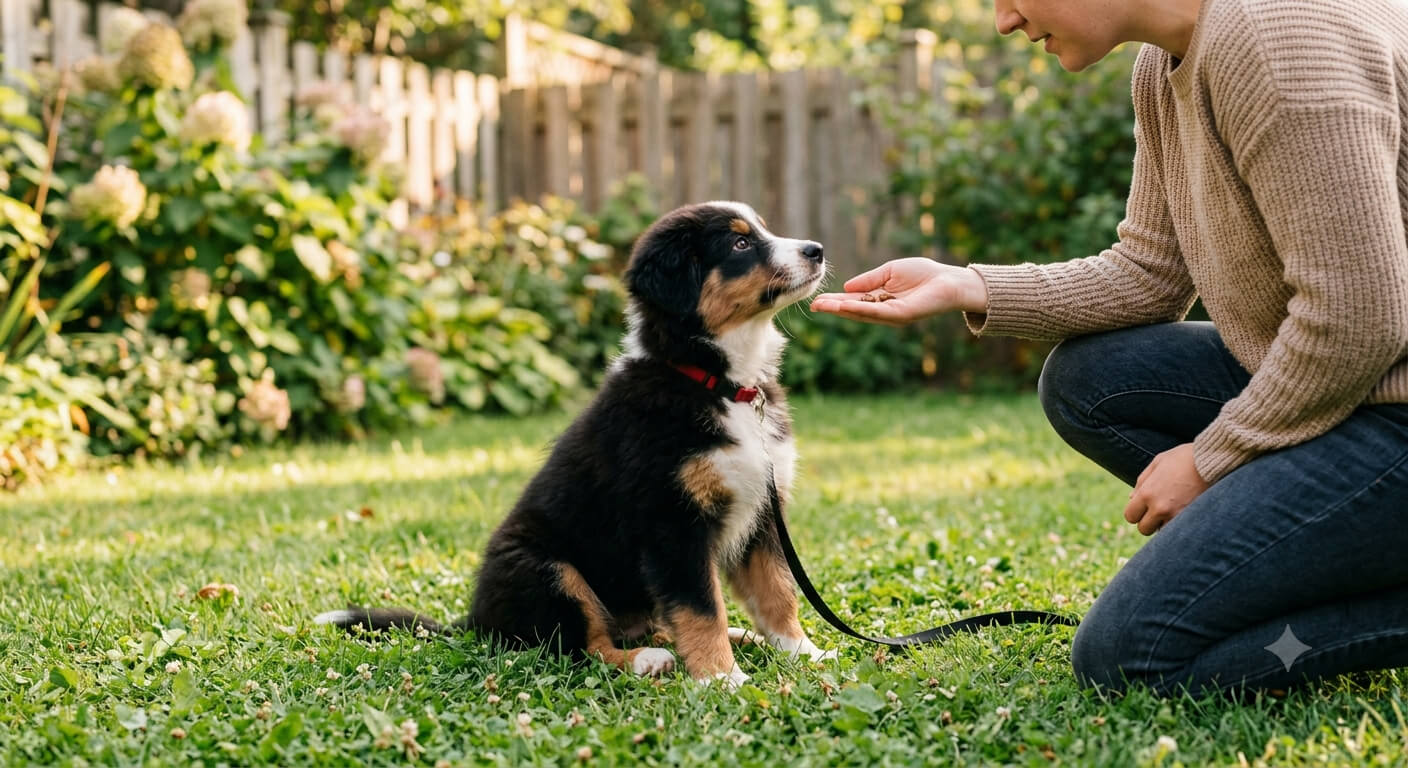
Puppy Training Schedule by Age: What to Teach and When
When you bring a puppy home, the question usually arrives quickly: what should my puppy actually know by now?
Typing "puppy training schedule by age" into a search bar often produces rigid syllabuses that resemble a school curriculum. Those charts suggest that your puppy should sit on command by eight weeks, heel perfectly at four months, and graduate as an obedient adult by their first birthday.
Real life with a puppy does not work that way. Puppies develop at different rates, and their behavior and attention vary as they grow.
This guide provides a practical, evidence-aligned framework for prioritizing training as your puppy grows from eight weeks through adolescence and into young adulthood. It is built around a simple truth:
Puppy training is cumulative, not a checklist of commands that must be completed by certain birthdays.
Early priorities should focus on safety, communication, reinforcement habits, socialization, gentle handling, toilet routines, foundational recall, comfortable rest, appropriate independence, and everyday life skills. Formal obedience cues such as sit, down, and stay are helpful tools, but they represent only a small part of raising a stable, confident dog.
How This Guide Fits With Your Routine
Raising a puppy involves several moving parts. To keep your efforts focused without repeating information:
- If you want to understand core learning principles, markers, and reward mechanics, read our guide on 10 Essential Training Tips for New Dog Owners.
- If you need help structuring your puppy's waking hours, naps, and meals, see our companion article on Puppy Schedule by Age: 8 Weeks to 12 Months.
- If you are currently working on bathroom habits, refer to our detailed Puppy Potty Training Schedule.
This article specifically answers the question that often creates the most anxiety: what specific training skills should you prioritize at each stage of development?
For a starting day that leaves room for those short training moments alongside meals and rest, try the Puppy Daily Schedule Generator.
Why Age Ranges Are Organizational Guides, Not Biological Deadlines
Before looking at specific age brackets, it is essential to understand how development works.
An age range is an editorial convenience to help owners structure their time. It is never a biological deadline. If your four-month-old puppy has not yet mastered a drop cue, or if your six-month-old puppy struggles to focus around other dogs, your puppy is not behind.
Puppy learning is shaped by numerous interconnected factors:
- Breed characteristics and individual genetics: A scent hound puppy has different natural motivations than a herding puppy or a toy breed.
- Temperament and individual response to novelty: Some puppies are naturally bold; others are cautious and need more time to process new situations.
- Previous life experiences: Early experiences before coming home can influence how a puppy responds to new situations.
- Environment: A quiet suburban home presents different learning challenges than a third-floor apartment in a busy city.
- Physical comfort and health: Teething discomfort, tired periods, and minor illnesses can affect a puppy's focus and responsiveness.
- Reinforcement history: Skills strengthen through repeated, successful practice in varied settings, not by reaching a specific age.
Avoid these common misconceptions:
- Every puppy must know a set number of commands by 12 weeks.
- Recall should be completely reliable by 6 months.
- Adolescence begins on an exact calendar date.
- Puppies enter a universal fear period at an exact week of age.
- Training becomes impossible once the early socialization period passes.
- A puppy should be fully trained and finished by one year of age.
Think of each stage as a foundation for the next. You move forward based on your puppy's individual progress, not the calendar.
Puppy Training Priorities by Age: Quick Summary
The following table outlines practical priorities for each stage. The third column lists examples of skills owners may be working toward, not benchmarks a puppy must achieve by that age. A puppy who cannot perform these examples is not behind.
| Age Stage | Main Training Priorities | Examples of Progress |
|---|---|---|
| 8 to 10 Weeks | Name recognition, rewarding voluntary focus, outdoor toilet routine, gentle following, positive equipment introduction, safe rest areas, gentle handling | Turning their head when their name is called in a quiet room; following you happily; settling into a designated sleep area |
| 10 to 12 Weeks | Foundational recall games, simple cues (such as sit), hand target following, gentle body handling, short grooming exposure, leash introduction, settling | Moving toward you in a quiet room when called; offering a sit to communicate; remaining comfortable during brief paw touches |
| 3 to 4 Months | Continuing recall practice, loose-leash foundations, positive trading and dropping objects, polite greetings, waiting briefly at doors, calm settling around activity | Exchanging a toy for a valued food reward; walking on a loose leash for short stretches in low-distraction spaces; resting on a mat during family meals |
| 4 to 6 Months | Practicing familiar skills in new environments, recall around mild distractions, outdoor loose-leash practice, cooperative handling preparation, redirecting chewing | Responding to familiar cues outside your living room; checking in with you after noticing a distant distraction; engaging with appropriate chew toys |
| 6 to 9 Months | Training through emerging adolescence, managing higher distractibility, long-line recall practice, adjusting training difficulty, managing the environment | Re-engaging with you on a long line after pausing to sniff; working through temporary distractibility with patience and appropriate rewards |
| 9 to 12 Months | Practicing skills in everyday contexts, polite greetings in public, steady leash walking, settling in novel environments, cooperative care routines | Walking calmly past neighborhood distractions; resting on a mat in public settings; cooperating during basic ear cleaning or nail checks |
| Beyond 12 Months | Young adult refinement, reinforcing everyday manners, continuing mental enrichment, deepening communication and cooperative partnership | Smooth recovery from surprises; predictable cooperation during daily routines; viewing training as an ongoing, enjoyable dialogue |
8 to 10 Weeks: Gentle Foundations and Household Harmony
The first two weeks in a new home are about adjustment, safety, and clear communication. Your puppy has just left their mother and littermates. Their primary need is to feel safe and understand how their new human household works.
At this age, formal obedience drills are unnecessary. The majority of meaningful training happens through your everyday routines and natural interactions.
Key Training Priorities
- Learning their name: Say your puppy's name in a clear, cheerful tone. The moment they look toward you, mark the behavior with a verbal marker like "yes" and deliver a small, puppy-appropriate food reward. Practice this briefly during natural daily interactions in low-distraction moments, gradually building a positive association with the puppy's name.
- Rewarding voluntary attention: Whenever your puppy chooses to look at you, check in, or walk in your direction without being prompted, reward them. Rewarding spontaneous attention teaches your puppy that keeping track of you is worthwhile.
- Beginning the toilet routine: Consistency starts immediately. Offer frequent toilet opportunities, particularly after waking, meals, active play, substantial drinking, and other routine transitions. Reward generously the moment elimination finishes outdoors.
- Encouraging natural following: Young puppies often have a natural tendency to follow their caretakers. Walk around your home or a secure yard, speaking warmly, and reward your puppy whenever they trot alongside you. This builds the foundation for leash walking without any gear tension.
- Gentle body handling: Pair gentle touch with small food rewards. Stroke a paw, feed a treat. Touch an ear, feed a treat. Look near the mouth, feed a treat. Positive, gradual handling can help puppies become more comfortable with being touched and with future grooming or veterinary handling.
- Positive equipment introduction: Let your puppy investigate their flat collar or harness. Pair putting the equipment on with small food rewards. Let them wear it for short, supervised periods indoors.
- Comfortable rest and confinement: Introduce their crate, playpen, or quiet puppy zone with open doors, soft bedding, and safe chew toys. For tips on helping your puppy settle without stress, see our guide on what to do when your Puppy Won't Nap.
- Early safe socialization: Begin gentle, controlled exposure to everyday sights and household sounds such as vacuum cleaners running at a distance, doorbells, washing machines, and different walking surfaces like wood, tile, and grass.
Keep expectations modest. An eight-week-old puppy does not need to sit on cue or perform tricks. Building trust and a stable daily routine is the true curriculum of this stage.
10 to 12 Weeks: Communication, Luring, and Confidence
Between ten and twelve weeks, many puppies become more curious and physically coordinated. Their attention span remains short, but they can begin to understand basic learning games.
The focus shifts toward building clear two-way communication and nurturing confidence.
Key Training Priorities
- Recall foundations in easy spaces: Call your puppy's name followed by a cheerful recall cue like "come!" from nearby in a quiet room or hallway. When they move toward you, mark the response and reward them generously.
- Hand targeting and luring: Hold a flat palm near your puppy's nose. When their nose touches your palm, mark with "yes" and reward. Hand targeting is a practical way to guide your puppy into position without pushing or pulling them.
- Introducing simple cues (such as sit): Using a piece of food held near the puppy's nose, guide the lure slowly upward and slightly back over their head. As the head tilts up, the rear naturally lowers. The moment the rear touches the floor, mark and reward. Keep it fun and pressure-free.
- Advancing gentle handling: Introduce a soft puppy brush with gentle strokes paired with rewards. Touch individual paws and look closely at the ears. Positive, gradual handling helps puppies build comfort with routine physical care.
- Leash introduction: Attach a lightweight leash to your puppy's harness or flat collar and let them follow you around a quiet room. Reward whenever the leash hangs loose. Avoid tugging or pulling the puppy along.
- Settling practice: Place a comfortable mat on the floor near where you work or relax. When your puppy steps onto the mat or lies down voluntarily, calmly deliver a treat between their front paws.
- Brief, comfortable separation: Help your puppy practice being alone in small steps. Place your puppy in their puppy-proofed zone with an engaging chew, briefly step away while the puppy is comfortable and engaged, then gradually increase difficulty based on their response.
Do not worry about strict command reliability. Focus on keeping interactions manageable and helping your individual puppy engage with learning and new experiences at a pace they can comfortably handle.
3 to 4 Months (12 to 16 Weeks): Everyday Life Skills
Between three and four months of age, puppies often explore more actively and show increasing physical coordination. This is an ideal stage to focus on functional life skills that support smooth household routines.
Key Training Priorities
- Continuing recall practice: Practice your recall cue across different rooms of your house and in a secure yard, gradually increasing distance and introducing mild distractions.
- Loose-leash walking foundations: Practice walking in low-distraction environments like a hallway, patio, or quiet driveway. Reward frequently whenever your puppy walks on a slack leash near your side.
- Positive trading and drop cues: Puppies explore the world with their mouths and will pick up forbidden household items. Never chase a puppy or pry their jaws open confrontationally. Instead, teach a positive exchange: present an appealing treat or another enticing toy near their nose so they willingly let go of the item to take the trade. Once the puppy consistently and willingly releases items during these exchanges, you can begin introducing a verbal cue like "drop" or "thank you" just as they decide to release it, rewarding generously each time.
- Teaching "leave it" through choice: Teach your puppy that turning away from an item on the floor earns a valuable reward from your hand. This builds self-directed hesitation rather than snatching.
- Polite greetings: Puppies frequently jump to reach human faces. The central principle is to reinforce the greeting behavior you want and avoid inadvertently rewarding jumping. One practical management strategy is to reward your puppy while all four paws remain on the floor during greetings. If they jump, you can stand still, turn sideways, and wait for all four paws to touch down before offering calm attention.
- Waiting briefly at boundaries: Ask for a brief, calm pause before opening exterior doors or placing down a food bowl. This can help reduce door-dashing risk and teaches the puppy that calm behavior can provide access to what they want.
- Settling around household activity: Encourage your puppy to rest on a designated bed while family members cook, eat dinner, or watch television, reinforcing calm resting with occasional quiet treats.
4 to 6 Months: Generalizing Skills to the Real World
Around four to six months, owners often notice that a puppy who responds reliably in the kitchen suddenly seems unable to perform the same behavior outdoors.
This is because dogs often need familiar skills practiced in different environments, as learning does not automatically transfer perfectly from one context to another.
To a young dog, the cue "sit" in a quiet kitchen is very different from "sit" in a park filled with novel scents, moving vehicles, and distant dogs.
Key Training Priorities
- Systematic generalization: Take behaviors your puppy knows well indoors and practice them in new locations, such as your front porch, a quiet sidewalk, or a friend's yard.
- Gradual distraction management: When entering a new, stimulating environment, temporarily make tasks easier. Reward simpler behaviors, such as looking at you or taking a single step on a loose leash, before asking for more complex responses. Increase difficulty gradually so your puppy can succeed.
- Recall around controlled distractions: Practice recall in your yard while someone walks nearby, or practice on an appropriately fitted harness and long line suitable for the individual dog and environment in an open, quiet area.
- Neighborhood loose-leash walking: Balance structured walking with exploratory sniffing. Sniffing is a normal exploratory behavior, and allowing appropriate sniffing can make walks more enriching and less focused on rigid heel work.
- Settling outside the home: Take a familiar travel mat to an outdoor patio or a quiet park bench. Sit calmly and reward your puppy for relaxing on the mat while the environment remains at a manageable distance.
- Cooperative handling preparation: Help your puppy become comfortable with routine care by gently touching ears, handling paws, briefly lifting lips, introducing grooming tools, and practicing calm standing on different surfaces.
- Redirecting chewing: Teething occurs during puppyhood, and puppies also commonly explore and interact with objects through chewing. Provide safe, appropriate chewing options, such as food-stuffed rubber toys and edible chews, to help satisfy their urge to chew.
6 to 9 Months: Training Through Emerging Adolescence
Some puppies may begin showing adolescent behavioral changes around this broad period, while the timing and duration vary substantially by individual and breed.
During adolescence, owners may notice greater interest in the environment, changing social behavior, or less consistent responses in distracting situations. You may observe:
- Higher distractibility during familiar exercises
- Slower responses to recall outdoors
- Stronger reactions to novel sights or sounds
- Increased interest in exploring away from the handler
- Fluctuating focus from one day to the next
Reframing Changing Behavior
When an adolescent puppy becomes less responsive, it is easy to assume they are being defiant or testing authority. Dominance narratives often resurface here, with advice urging owners to crack down.
These interpretations are unhelpful. Decreased responsiveness in distracting settings does not mean previous training has disappeared, nor does it mean the dog is deliberately stubborn. Instead, environmental distractions may become more difficult to compete with, and the dog may need more support to succeed.
Practical Strategies for Training
- Lower task difficulty temporarily: If your puppy struggles to respond near a distraction, increase your distance until they can focus comfortably.
- Increase reinforcement value: Use high-value rewards that your puppy finds genuinely motivating when working in distracting environments.
- Use an appropriately fitted harness and long line: Avoid testing recall off-leash in unfenced or unsecured areas. Use an appropriately fitted harness and long line suitable for the individual dog and environment. Long lines require active supervision and should be used away from traffic and other entanglement hazards to allow safe exploration while preventing the puppy from practicing running away when called.
- Manage the environment: Management can reduce opportunities to repeatedly practice unwanted behavior while you teach an alternative. Use baby gates, leashes, or distance to keep interactions manageable.
- Protect rest and quiet routines: Growing dogs still need adequate rest. Predictable daily routines help balance physical exercise, mental enrichment, and quiet downtime.
9 to 12 Months: Reliability, Real Life, and Cooperative Care
As dogs approach their first birthday, physical and behavioral development continue at different rates depending on breed, size, and the individual dog.
During this phase, training shifts toward refining skills in everyday contexts, maintaining polite manners, and supporting emotional stability.
Key Training Priorities
- Real-world recall practice: Continue practicing recall in varied outdoor environments using a suitable long line for safety. Reward successful returns generously, and frequently release your dog back to exploring so recall does not become an automatic end to fun.
- Polite greetings in public: Teach your dog to walk calmly past pedestrians and other dogs on leash without straining to greet them. Social neutrality is a practical and attainable goal for public outings.
- Settling in diverse environments: Practice resting quietly on a mat at outdoor cafes or quiet public spaces, rewarding relaxed postures around normal pedestrian movement.
- Cooperative care routines: Continue cooperative grooming and care habits, such as voluntary chin rests or calm standing during brushing, paw wiping, or ear cleaning.
- Supporting comfortable independence: Comfortable alone time remains a useful life skill to practice gradually according to the individual dog, ensuring they feel secure when left for routine periods.
- Maintaining reinforcement: Maintaining reinforcement can help preserve learned behaviors, especially difficult or safety-critical ones. While you do not need to reward every basic response forever, continuing to acknowledge good choices keeps behaviors strong.
Training is an ongoing process that extends well beyond a dog's first year.
Beyond 12 Months: Young Adulthood and Lifelong Learning
Reaching twelve months is a significant milestone, but social and behavioral maturity develops gradually and varies substantially between individual dogs and breeds.
As dogs mature, their social preferences may change. Some adult dogs become more selective about which dogs they interact with, preferring calm coexistence over intense play. Continuing to practice foundational manners, reliable recall, and enjoyable mental games keeps your dog mentally stimulated and maintains clear communication throughout their life.
Socialization Throughout Training: Quality Over Quantity
Socialization is frequently misunderstood as an urgent race to expose a puppy to as many people and dogs as possible before sixteen weeks. That approach often leads to an overstimulated or anxious puppy.
Realistic Framing for Socialization
The American Veterinary Society of Animal Behavior (AVSAB) identifies the first three months of life as the primary and most important period for puppy socialization, when puppies are naturally more open to new experiences.
Key principles to keep in mind:
- Socialization does not end abruptly. While early puppyhood is a critical window, social learning and confidence building continue throughout puppyhood, adolescence, and adulthood. Never assume an older puppy cannot learn or adapt.
- Safe exposure can begin before vaccination is complete. The AVSAB emphasizes that behavioral issues are a leading cause of pet relinquishment and recommends safe, early socialization before vaccinations are fully finished, provided disease risks are managed appropriately.
- Discuss local health risks with your veterinarian. Depending on local disease risk and veterinary advice, lower-exposure approaches may include carrying the puppy, observing from a stroller or vehicle, or arranging controlled interactions in suitable environments with known healthy dogs, along with exposing them to diverse sounds, car rides, and surfaces without placing them on high-risk public ground.
Focus on Safe, Positive Exposure
Good socialization does not require direct interaction with everything. Calm observation, positive experiences, and the ability to disengage can all be valuable outcomes.
- Allow your puppy to observe people in hats, delivery trucks, bicycles, and other dogs from a comfortable distance.
- Always allow the puppy the choice to move away if they feel uncertain. Forcing an uncomfortable puppy toward a scary stimulus can create lasting fear.
- Food or other valued rewards can be used to support positive experiences around new stimuli.
For practical steps on setting up safe exposure, read our dedicated guide on Socializing Your Puppy: A Step-by-Step Guide, and learn how to recognize subtle comfort levels in our overview of Dog Body Language.
Building a Reliable Recall Step by Step
Recall is an important safety and everyday-life skill. It allows your dog safe freedom while giving you the ability to call them away from potential hazards.
Building a dependable recall requires consistent, patient practice over time.
Practical Principles for Recall
- Start in low-distraction environments: Begin inside a quiet room with your puppy nearby. Only increase distance and introduce outdoor distractions once your puppy responds reliably in simpler settings.
- Choose an appropriate reward: Choose a reward valuable enough for the individual dog and the difficulty of the environment. High-value food, a favorite toy, or a lively game can all serve as effective reinforcers.
- Avoid repeatedly pairing recall with unpleasant events: Avoid teaching your dog that recall reliably ends enjoyable activities or predicts something they dislike. If you must call your dog away from fun, reward them generously, and whenever safe, release them back to play.
- Avoid repeating the cue when success is unlikely: If your puppy is deeply engaged in sniffing and unlikely to respond, calling repeatedly teaches them that the cue can be ignored. Move closer, gain their attention, and make the next repetition easier.
- Do not punish a dog after they return to you: Regardless of how long it took your dog to return, never scold or correct them upon arrival. Punishing a dog when they reach you teaches them that approaching you is risky.
- Use an appropriately fitted harness and long line: Use an appropriately fitted harness and long line suitable for the individual dog and environment. Long lines require active supervision and should be used away from traffic and other entanglement hazards, providing safety during outdoor practice while preventing your dog from rehearsing ignoring your call.
Loose-Leash Walking Without Corrections
Many owners assume that leash walking requires rigid competition heel work, with the puppy walking stiffly at the handler's leg.
In daily life, a formal heel is rarely necessary. Sniffing is a normal and enriching part of canine exploration. The practical goal is loose-leash walking, where the puppy moves comfortably without pulling the handler and the leash remains slack.
Foundations for Walking Together
- Reward the zone near your hip: Whenever your puppy walks alongside you with a slack leash, mark with "yes" and deliver a small reward near your side to build value for that position.
- Stop when tension occurs: If your puppy pulls, stop moving smoothly. The moment the leash relaxes or your puppy checks in with you, mark and resume walking.
- Use gentle direction changes: If your puppy surges ahead, turn calmly in another direction, encouraging them to follow with a light, cheerful voice. Reward as they catch up.
- Incorporate sniffing breaks: Allow ample opportunities for your puppy to sniff at their own pace. Allowing appropriate sniffing makes walks more enriching and less focused on rigid walking drills.
Avoid leash jerks and aversive tools such as prong, choke, or electronic collars. Veterinary behavior organizations recommend reward-based methods and warn that aversive training can negatively affect welfare and behavior.
Handling and Cooperative Care: A Top Priority
Body handling and cooperative care are essential parts of puppy raising. Over their life, your dog will encounter veterinary examinations, nail care, ear checks, and grooming.
Gradual cooperative-care practice can help reduce stress associated with routine handling, grooming, and veterinary care.
Steps for Gentle Handling
- Touch in small, comfortable steps: Touch a paw briefly, deliver a treat, and remove your hand. Repeat gradually while keeping the puppy relaxed.
- Introduce grooming tools slowly: Let your puppy inspect a brush or nail clipper while receiving rewards. Gently touch the tool handle to their body before attempting any actual grooming.
- Practice basic veterinary-style handling: Help your puppy become comfortable with routine care by gently touching ears, handling paws, briefly lifting lips, and practicing calm standing on different surfaces.
- Respect comfort signals: If your puppy pulls away, stiffens, or shows signs of stress, do not forcibly hold them down to finish. Forcing a frightened puppy can increase fear. Pause, make the step smaller, and resume with patience and rewards.
Biting, Mouthing, and Chewing
Puppy mouthing is one of the most common concerns for new owners. Sharp puppy teeth can cause frustration and worry about aggression.
Puppy mouthing is normal developmental behavior. Puppies commonly use their mouths during exploration and play, and chewing can also occur during the teething period.
Practical Management Strategies
- Keep toys accessible: Proactively offer a soft toy or chew before teeth make contact with hands or clothing during play.
- Briefly pause the interaction: If your puppy bites skin or clothing, briefly pause or end the interaction. Stepping behind a gate or standing still helps the puppy learn that sharp biting stops the fun.
- Provide varied chewing textures: Offer safe chew toys, food-stuffed rubber toys, and edible chews to satisfy their physical urge to chew.
- Consider rest: Increased mouthing or activity can occur in many contexts. If the puppy has been awake and active, offering a quiet opportunity to rest can be reasonable, but biting alone does not prove overtiredness.
- Avoid physical punishment: Physical punishment can cause fear, distress, or defensive responses and is unnecessary for teaching appropriate mouthing behavior.
How Long Should Training Sessions Be?
Rigid rules prescribing a set number of minutes per session or formulas based on age do not reflect how learning happens.
Keep training interactions short enough that the puppy remains engaged and successful. For some puppies or exercises this may be only a few repetitions, while others may comfortably continue longer.
Integrating Training Into Daily Routines
Effective training often fits naturally into everyday moments:
- Asking for a calm sit before placing down a food bowl
- Calling your puppy across a quiet room during daily activities
- Practicing a loose-leash turn in the hallway before heading out the door
- Gently touching paws and rewarding with a treat during quiet time
When to Pause Training
Pause or simplify an exercise if:
- Your puppy becomes distracted, looks away repeatedly, or wanders off
- The puppy displays frustration or over-arousal
- You find yourself feeling impatient or frustrated
When practical, finish while the puppy is still engaged rather than continuing until frustration develops.
Choosing and Using Rewards Wisely
Positive reinforcement relies on rewards that the individual puppy values in the moment.
Types of Reinforcers
- Food rewards: Small food rewards are practical and easy to deliver precisely.
- Play and toys: A brief game of tug or fetching a toy can be highly reinforcing for play-motivated dogs.
- Environmental access: Sniffing a patch of grass or greeting a family member can reward calm behavior.
- Praise and attention: Gentle touch and cheerful vocal praise are rewarding for many puppies, especially alongside other reinforcers.
Managing Daily Food and Rewards
To maintain balanced nutrition while training:
- Use part of the puppy's regular complete and balanced food for training when practical.
- For more challenging environments, incorporate a small, puppy-appropriate reward that the individual dog values highly.
- Account for training treats within the puppy's overall daily dietary intake to avoid overfeeding.
For detailed advice on meal schedules and daily feeding, see our guide on How Often Should You Feed a Puppy? Daily Feeding Schedules by Age.
Common Training Mistakes to Avoid
Recognizing common missteps helps keep training clear and productive:
- Expecting too much too soon: Expecting early perfection in distracting environments sets both owner and puppy up for frustration.
- Repeating verbal cues: Repeating cues can make communication less clear if the puppy learns that responding to the first cue is unnecessary. Say the cue once, and if the puppy cannot respond, help them succeed by reducing difficulty.
- Increasing distractions too quickly: Moving from a quiet kitchen directly into a high-distraction environment can cause performance to break down. Add distractions gradually.
- Inadvertently reinforcing unwanted behavior: Some forms of attention can inadvertently reinforce jumping in some dogs. Wait for four paws on the floor before giving attention.
- Inconsistent household rules: Differing expectations among family members can create confusion. Agree on simple, shared routines.
- Calling only to end enjoyment: Calling a dog only when play must end can make recall unappealing. Reward recall frequently and release the dog back to play whenever appropriate.
- Relying on intimidation or punishment: Aversive training methods can negatively affect welfare and the human-dog relationship and are unnecessary for teaching desired alternatives.
- Misinterpreting missed cues: A missed cue can reflect many things, including distraction, insufficient learning history in that context, discomfort, or a task that is currently too difficult.
What to Do When Training Suddenly Seems Worse
It is normal for training progress to fluctuate. A puppy who seemed reliable one week may struggle the next.
Performance can vary depending on context, including:
- Environmental distractions and novelty
- Fatigue or inadequate rest
- Teething discomfort
- Developmental changes during adolescence
- Insufficient practice in a specific setting
When to Consider Health and Veterinary Evaluation
Sudden behavioral changes can sometimes have a medical component, so significant or persistent changes deserve veterinary attention when appropriate.
Consult your veterinarian if behavioral changes accompany:
- Lethargy or reduced interest in normal activities
- Decreased appetite or difficulty chewing
- Flinching, vocalizing, or discomfort when touched
- Gait changes or reluctance to move comfortably
- Straining or difficulty urinating
- Scratching at ears or shaking the head
Ensuring your puppy is physically comfortable is always a sound first step.
Tracking Training Progress: Seeing the Big Picture
Day-to-day progress with a puppy can be subtle and easily overlooked during challenging moments.
Recording simple, qualitative observations helps you notice patterns over time:
- Skill practiced: For example, recall, mat settling, or loose-leash walking.
- Environment: Kitchen, driveway, or neighborhood sidewalk.
- Distraction level: Low, medium, or high.
- What went well: Practical wins, such as quick check-ins or calm pauses.
- What felt difficult: Contexts where the puppy needed more distance or support.
Patterns can help you identify contexts worth paying attention to, but a log does not prove why a behavior occurred. Tracking simply provides useful perspective on how your puppy is progressing.
For an overview of tracking routines without feeling overwhelmed, see our guide on Puppy Daily Routine: What to Track in the First Year.
How Dogtales Supports Your Puppy's Development
Keeping track of daily habits, outdoor trips, training observations, and veterinary care across multiple notes can become difficult to manage.
Dogtales provides a convenient place to log daily routines, activities, training notes, and health-related observations alongside meals and sleep. Having a clear, chronological record makes it easier to look back on patterns and share helpful details with your veterinarian or trainer.
Dogtales does not determine why behavior occurred, evaluate training quality, diagnose behavior, predict behavior, prescribe training, or replace a veterinarian or qualified trainer. It simply keeps your daily records organized in one accessible place.
A Welcome Offer for New Puppy Owners
Got a new puppy, or getting ready to bring one home? Reach out to us through our contact page. If you are starting your first year with a new puppy, the Dogtales team is happy to provide you with a discount code for your first year of Dogtales.
When to Seek Professional Guidance
You do not need to wait for a severe problem before consulting a professional. Early guidance can make training clearer and less stressful.
- Reward-based trainers and behavior consultants: Because dog training is not uniformly regulated, evaluate both a professional's education or credentials and the methods they actually use. Ask directly whether they use reward-based methods and avoid aversive tools and techniques. Credentials such as CPDT-KA, KPA-CTP, or IAABC accreditation can indicate formal education in reward-based training, but owners should always verify that the practitioner avoids punitive methods, noting that specific scopes of practice vary.
- Veterinary involvement: Consult your veterinarian whenever behavioral changes arise suddenly or could involve pain, illness, or physical discomfort.
- Prompt professional help: Seek prompt help from a qualified behavior professional or veterinary behaviorist when there is escalating aggression, a meaningful bite risk, severe or persistent fear, significant separation-related distress, guarding that creates safety concerns, or sudden major behavioral changes.
Getting appropriate support early protects your puppy's welfare and gives you confidence.
Frequently Asked Questions
When should I start training my puppy?
Training begins the day your puppy arrives home. Early training does not mean formal obedience drills. It focuses on gentle routines, learning their name, rewarding voluntary attention, introducing bathroom habits, and helping the puppy settle comfortably into their new home.
What should I teach my puppy first?
Prioritize practical life skills before formal cues. Useful starting points include establishing an outdoor toilet routine, teaching that their name predicts positive interaction, encouraging natural following, practicing gentle body handling, and providing a quiet, secure rest area.
What should an 8-week-old puppy know?
An eight-week-old puppy does not need to know a list of commands. They are adjusting to an entirely new environment. Training at this stage focuses on safety, gentle routines, positive experiences with people, and beginning to learn where to toilet.
What should a 3-month-old puppy know?
Training history varies widely by three months. Many owners are beginning to practice name recognition, simple luring exercises such as sitting, following a loose leash in quiet areas, and trading toys for food rewards. These are skills in progress, not expectations of mastery.
What should a 6-month-old puppy know?
Puppies develop at different rates, and what a puppy knows at six months depends heavily on their individual learning history. Owners may be strengthening foundational behaviors such as recall, settling, and loose-leash walking, while beginning to practice them across more varied environments. Fluctuations in responsiveness are common as dogs develop.
When should a puppy learn recall?
Foundational recall practice can begin during the puppy's first weeks home using simple, playful games across short distances in quiet rooms. As the puppy matures, owners can gradually increase distance and introduce mild distractions, using an appropriately sized long line for safety outdoors.
How long should puppy training sessions be?
There is no fixed duration for a puppy training session. Keep interactions short enough that the puppy remains engaged, motivated, and successful. Ending while the puppy is still focused helps keep training positive and productive.
Why does my puppy suddenly seem to ignore training?
Changing performance can have many explanations, including environmental difficulty, incomplete generalization across new locations, developmental changes, fatigue, physical discomfort, or insufficient reinforcement history in that setting. Adjusting difficulty and checking for physical comfort are good first steps.
Is my puppy behind in training?
Training progress varies widely between puppies, so age alone is not enough to determine whether a puppy is behind. Differences in breed, temperament, health, environment, and reinforcement history all shape learning speed. Focus on steady, positive progress with your individual dog rather than comparing them to rigid milestone checklists.
Share this article
Keep your dog healthy and happy with Dogtales
Track meals, medication, potty breaks, weight, vaccinations, and daily reminders in one intuitive app.
Related Articles
How Long Can a Puppy Hold Their Pee?
Learn how long puppies can realistically hold their pee by age, why bladder capacity is not the same as a potty schedule, and what changes during sleep, play, crate time, and time home alone.
Puppy Potty Training Not Working? 9 Common Mistakes
Still dealing with puppy potty accidents? Learn nine common potty training mistakes, why they happen, and practical ways to get your puppy's routine back on track.
Puppy Potty Training Schedule: A Complete Guide
Build a practical puppy potty training schedule around waking, meals, naps, play, and bedtime. Learn how to prevent accidents, reward success, and adapt the routine as your puppy grows.