
Puppy Won’t Nap? How to Build a Better Rest Routine
Puppy won’t nap or settle during the day? Learn why puppies struggle to rest and how to build a calmer, more practical nap routine without relying on rigid sleep schedules.
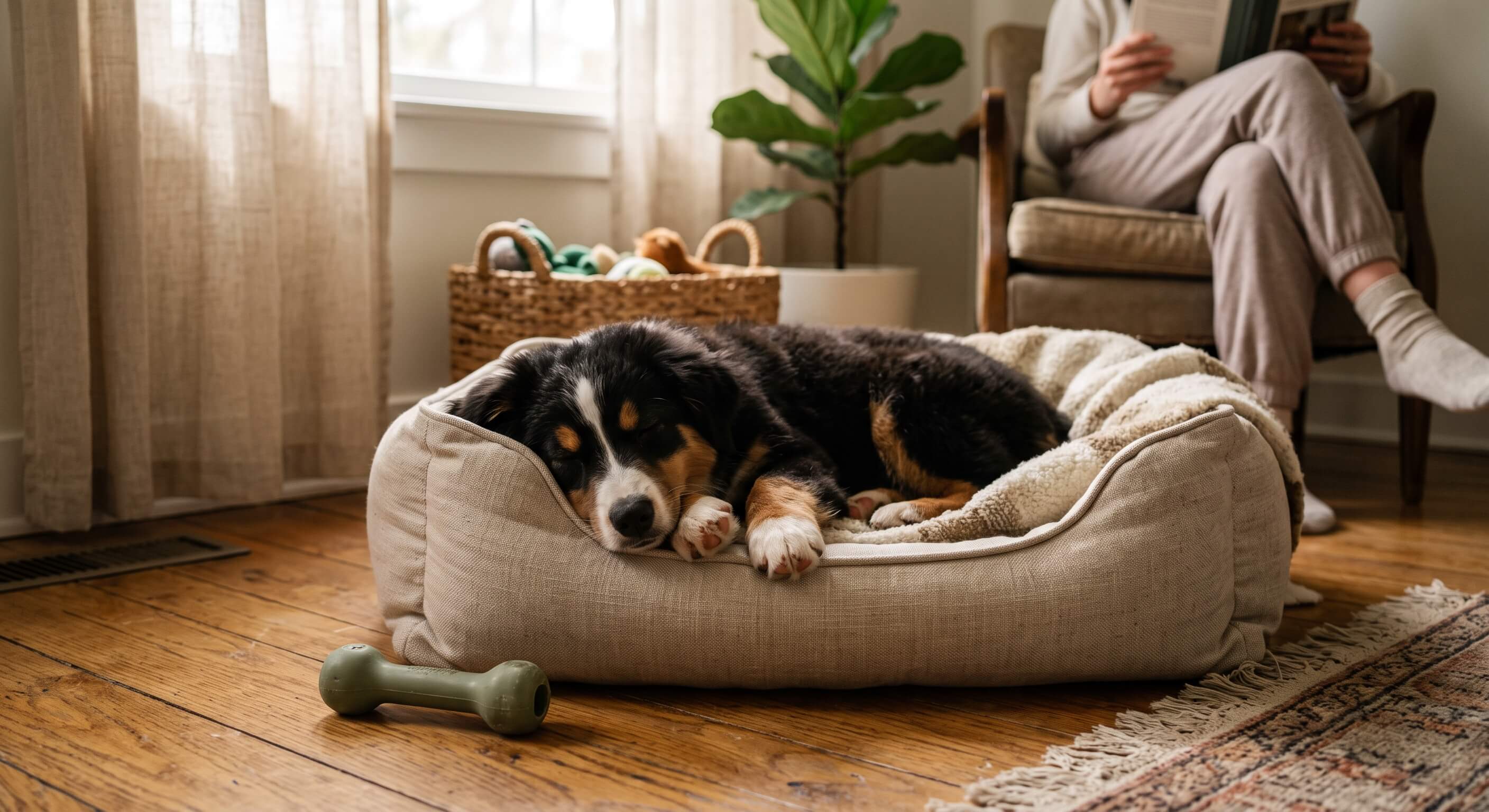
Puppy Won’t Nap? How to Build a Better Rest Routine
You have fed your puppy, taken them outside to pee, and spent some time playing on the living room rug. By every reasonable expectation, your puppy should be ready to collapse into a long, quiet snooze. Instead, they are pacing across the floor, biting at your socks, whining by your feet, or shadowing you into the kitchen every time you stand up.
When your puppy won’t nap during the day, it is easy to feel overwhelmed. New puppy owners frequently wonder whether they have a puppy fighting sleep, whether they are doing something wrong, or if their puppy simply has endless energy that needs to be exhausted through more play. If you are searching for how to get a puppy to nap when every attempt ends in frustration, you are not alone.
The reality is much simpler: young puppies need a lot of rest. While sleep itself is a natural biological need, puppies vary in how easily they settle within a busy household environment, and owners can often make rest easier through thoughtful routine and environmental management.
The core truth to keep in mind is straightforward:
You cannot force a puppy to sleep, but you can create conditions that make settling and uninterrupted rest much easier.
The solution is not to run your puppy until they collapse from physical exhaustion. Instead of forcing naps or trying to fit your puppy into a rigid internet sleep chart, this guide walks through why puppies struggle to rest and how to build a practical puppy nap routine that works for your home.
1. Why Won’t My Puppy Nap?
Puppies are curious, socially focused animals whose habits and focus are still developing. Unlike an adult dog who has spent years learning how to ignore the dishwasher, sleep through a television show, and curl up when bored, a young puppy reacts to almost every sensory change in their environment.
When an owner asks why their puppy won’t sleep during the day, the situation usually looks like one of these familiar scenarios:
- The puppy follows you everywhere: Every time you step into the kitchen, walk toward the bathroom, or get a glass of water, your puppy jumps up to follow you rather than staying asleep.
- The puppy wakes at the slightest movement: Even if they manage to close their eyes, the sound of a closing door or shifting floorboards wakes them instantly.
- The puppy gets increasingly wild instead of resting: As the day progresses, the puppy becomes more mouthy, frantic, and unfocused, yet seems completely unable to lie down.
- The puppy settles only when held: A puppy won’t sleep unless held or resting directly against your lap, but protests the moment you set them on a dog bed or inside a puppy pen.
- The puppy sleeps well at night but refuses daytime rest: Nighttime feels quiet and predictable, but daylight brings too much visual and auditory excitement for the puppy to switch off.
- The puppy rests in one spot but hates another: They happily curl up under the dining table or behind a couch, but become distressed when placed inside a crate or gated area.
In nearly all of these cases, the puppy is not being stubborn, manipulative, or difficult. In many cases, something about the puppy's environment, physical needs, or routine is making it difficult to settle.
2. First, Is Your Puppy Actually Tired?
A popular trend on social media and puppy forums is to diagnose any unruly puppy behavior as "overtiredness." If a puppy gets the zoomies, nips at sleeves, barks at family members, chews on furniture, or runs around in circles, owners are told that their puppy is definitely overtired and needs to be placed into a crate immediately. Many owners find themselves searching for answers when their puppy overtired but won’t sleep seems to be running on fumes.
That claim is an oversimplification.
A tired or overstimulated puppy can certainly have more difficulty settling and engaging calmly. However, wild behavior, biting, barking, and restlessness have many everyday causes:
- Normal puppy energy and play drive: Puppies are playful animals that experience natural peaks of energy throughout the day.
- Teething discomfort: Sore gums and teething can contribute to chewing, mouthing, or restlessness as a puppy looks for ways to soothe their mouth.
- Needing to eliminate: An urge to pee or poop often causes pacing, restlessness, and frantic activity.
- Hunger or thirst: A puppy whose tummy is rumbling or who needs a drink of water cannot settle peacefully.
- Need for mental exploration: A puppy who has only had physical exercise may still feel mentally under-stimulated and seek engagement through chewing or barking.
- Social excitement: Visitors arriving, children coming home, or new scents entering the house naturally raise a puppy's arousal level.
Instead of jumping straight to the conclusion that your puppy is fighting sleep purely because they are overtired based on a single behavior, look at the broader context of their day:
- How long has the puppy been awake and moving around?
- What kind of stimulation have they encountered recently (a quiet garden explore versus a hectic trip to the pet store)?
- Have their core physical needs been met (potty, meal, water, comfortable temperature)?
- Has the puppy been given a calm, quiet place where rest is actually possible?
- Does this behavior represent a sharp change from their normal daily pattern?
The Problem with Rigid "Wake Windows"
Many puppy training schedules online prescribe strict, minute-by-minute wake windows, such as "one hour awake, two hours asleep," "45 minutes awake," or "naps every two hours."
There is no universal wake-window formula that every puppy must follow.
Young puppies generally alternate periods of wakefulness with frequent rest, and their capacity to stay awake comfortably lengthens as they grow older. However, individual puppies differ naturally in their waking and resting patterns based on age, temperament, activity levels, environment, and other factors.
Trying to force an individual puppy to sleep at an exact minute on a clock creates unnecessary stress for you and your puppy. When learning how to get a puppy to nap reliably, it is far more practical to observe your puppy's natural rhythms than to force them into an artificial schedule.
To learn more about normal sleep expectations across development, see our guide on How Much Should a Puppy Sleep? or explore our full overview in Puppy Sleep Schedule by Age.
3. Common Reasons Puppies Struggle to Settle
When a puppy won’t settle for naps, it is useful to consider their environment, routine, physical needs, comfort, and recent activity. Here are several common factors that can influence daytime rest.
Too Much Stimulation
Modern households are filled with sights, sounds, and smells. A television playing in the background, family members walking between rooms, outdoor traffic, washing machines humming, and phones pinging can all catch a young puppy's attention. A busy environment can make it harder for some puppies to disengage and settle, especially in the middle of a lively family room.
Not Enough Opportunity for Quiet Rest
Some puppies struggle to nap because their owners, with the best of intentions, keep them constantly engaged. If someone in the home is always throwing a toy, talking to the puppy, offering treats, or petting them whenever they lie down, the puppy never receives a clear signal that interaction has ended. Without designated quiet periods where nothing exciting is happening, puppies continue to search for play.
The Puppy Keeps Following You Instead of Sleeping
Young puppies naturally prefer to stay close to their people. If a puppy has unrestricted access to the entire home, they will often get up every time you walk from the couch to the kitchen. Frequent interruptions like this can make sustained rest more difficult, leaving the puppy in a cycle of brief, fragmented dozing throughout the day.
The Sleeping Area Is Too Busy
Where a puppy sleeps matters just as much as when they sleep. If the puppy's crate, pen, or bed is positioned in a central hallway, next to a front window, or right beside the kitchen counter, every passing footstep becomes a potential wake-up call. Even if the puppy wants to rest, their vigilance keeps them listening for every household event.
The Puppy Has Learned That Rest Time Means Separation
If confinement or separation is introduced too abruptly, some puppies may become distressed rather than settling. A puppy who feels uneasy about sudden isolation may spend their rest time whining, pacing, or searching for their caregiver rather than relaxing into sleep.
Physical Comfort: Potty, Hunger, Thirst, and Temperature
A puppy cannot settle peacefully if their body is telling them something is wrong:
- Bladder or bowel pressure: A puppy who needs to eliminate will often pace, circle, or whimper. Even after a recent potty trip, activity, eating, or drinking may mean another opportunity is useful. For more on managing bathroom needs, see our Puppy Potty Training Schedule and How Long Can a Puppy Hold Their Pee?.
- Hunger or thirst: Hunger can sometimes contribute to restlessness depending on the puppy's normal feeding routine. Similarly, lacking normal access to fresh water can leave a puppy thirsty and uncomfortable. You can read more about coordinating meals with rest in our Puppy Feeding Schedule by Age.
- Temperature: An uncomfortable room temperature or unsuitable bedding can make it harder for a puppy to settle. A thick fleece bed in a warm room can cause discomfort, leading the puppy to seek cold tile or wood floors to cool down, while cold drafts near exterior doors can make resting unpleasant.
- Physical soreness: Teething aches, minor tummy upsets, or itchy skin can make lying in one position uncomfortable.
4. How to Build a Better Puppy Nap Routine
The most reliable way to help a puppy settle is to replace rigid timetables with predictable event-based sequences.
Puppies do not read clocks, but they respond well to predictability. Repeating a similar low-key sequence can make the transition from activity to rest more predictable for both puppy and owner.
One possible pre-rest sequence looks like this:
This sequence is only an example, not a required five-step formula. Depending on your puppy and household, rest may happen naturally after breakfast, after a gentle training session, or following quiet outdoor time. The specific time of day matters far less than the predictability of the transition.
What Should Happen Before a Nap?
What happens shortly before a rest period can influence how easily some puppies settle.
A very common mistake is engaging in high-intensity exercise right up to the moment of rest. Playing vigorous games of fetch, encouraging rough tug-of-war, or letting the puppy sprint across the yard immediately before nap time can backfire. Highly stimulating activity immediately before a planned rest period can make it harder for some puppies to settle, often leading to restless pacing or vocalizing when placed in their sleeping area.
Instead, create a gentle wind-down transition:
- Keep the pre-nap potty break boring: Step outside on a leash, stand in your puppy's designated toilet spot, and give them a few minutes to eliminate without turning the trip into a game of chase.
- Offer low-arousal enrichment: Some puppies find quiet activities such as sniffing, licking, or chewing useful as a transition from active play to rest. Providing a safe chew, a snuffle mat with a few kibbles, or a rubber toy with a smear of puppy-safe food can help them wind down.
- Avoid intense handling: Keep your movements and voice calm, quiet, and deliberate.
5. Step-by-Step Rest Troubleshooting Sequence
When your puppy won't settle for a nap and seems restless, mouthy, or unable to switch off, work through this practical step-by-step checklist rather than guessing:
| Step | Action | Why It Helps |
|---|---|---|
| 1. Offer a calm potty break | Take the puppy to their toilet area on a leash and offer a calm potty opportunity. | Relieves physical bladder or bowel urgency that prevents settling. |
| 2. Check basic physical comfort | Ensure fresh water was accessible, the room is not too hot or cold, and bedding is clean. | Eliminates subtle physical discomforts like thirst or overheating. |
| 3. Lower environmental stimulation | Dim overhead lights, draw curtains, lower TV volume, and reduce foot traffic. | Removes visual and acoustic triggers that keep the puppy alert. |
| 4. Move to the usual resting space | Guide the puppy to their familiar bed, puppy pen, or crate. | A familiar resting place can make the routine more predictable. |
| 5. Offer a quiet transition | Provide a safe rubber chew, a small snuffle mat, or sit quietly beside them. | Helps the puppy disengage from excitement and focus on a calm activity. |
| 6. Give the puppy time to settle | Step back and give the puppy a little quiet time to see whether they settle, without talking or making eye contact. | Gives the puppy space to reposition, sigh, and drift off naturally. |
| 7. Reassess if distress escalates | If the puppy displays rising panic rather than mild settling whines, intervene calmly. | Allows you to respond if the puppy is becoming increasingly distressed rather than settling. |
| 8. Track patterns across several days | Note what helped and what caused friction on a daily timeline. | Identifies trends and triggers without judging your puppy on one difficult day. |
6. Creating a Good Puppy Sleep Environment
A suitable resting environment can make settling easier, while a busy or uncomfortable environment can make it more difficult. Supporting restful sleep generally involves four main factors:
Location
Choose a resting spot that is separate from major household thoroughfares, but not completely isolated from family life. A quiet corner of a living room behind a sofa, a home office, or a spare room with a baby gate often works much better than a noisy kitchen or a distant, pitch-black basement. Choose a location where the puppy can rest comfortably without unnecessary household disturbance.
Lighting and Visual Stimulation
Darkness is not required for daytime puppy sleep, but some puppies settle more easily in a quieter space with less visual stimulation. If your puppy watches every passing movement, closing blinds, drawing curtains, or partially covering a wire crate with a light, breathable sheet can create a calmer space that helps them relax.
Managing Household Noise
You do not need to keep your home in absolute, library-like silence. Attempting to make the house completely silent is rarely practical, and ordinary household activity is a normal part of life.
As an optional environmental strategy, some owners find that gentle background sound can help some puppies by making sudden noises less noticeable. An oscillating fan, a white noise machine, or a soft radio can be useful if sudden outside noises or doorbells frequently disturb rest, but background sound is not required for a puppy to learn to rest in a normal home.
Bedding and Temperature Options
Puppies often shift positions while resting to regulate their body temperature. Some puppies love soft, padded bolster beds where they can tuck their nose into a cushion. Others find plush beds uncomfortably warm and prefer lying flat on a firm, breathable canvas mat or even the bare floor.
Watch where your puppy chooses to collapse when left to their own devices. If they consistently choose the cool kitchen tiles over a fluffy dog bed, consider giving them a resting setup with a firmer, cooler surface.
7. Should You Use a Crate or Puppy Pen for Naps?
There is significant debate among dog owners regarding whether puppies must sleep in crates. If your puppy won’t sleep in crate during day hours, you might wonder whether crate training is strictly required.
Crate training is not mandatory.
When introduced thoughtfully and gradually with positive reinforcement, a crate can help keep a puppy safe when direct supervision is not possible and can be useful as part of a housetraining plan.
However, a crate is not a magical tool that automatically teaches a puppy how to settle. Forcing confinement before a puppy is comfortable with it can increase distress and may make crate training more difficult.
If a crate works well for your puppy, that is wonderful. But if your puppy won’t sleep in crate setups during the day despite patient training, several excellent alternatives provide safety and structure:
- An exercise pen (x-pen): A sturdy puppy pen provides more open space, allowing room for a comfortable bed, a water bowl, and a safe chew without feeling tightly enclosed.
- A puppy-proofed quiet room: A laundry room, home office, or small spare bedroom secured with a tall baby gate allows the puppy to see and hear the household while keeping them confined to a safe resting zone.
- A gated quiet alcove: Using baby gates to block off a low-traffic section of a hallway or living room corner gives the puppy clear physical boundaries without full enclosure.
- A dedicated dog bed in a low-traffic corner: For puppies that settle well on their own without chewing cords or wandering, an open bed paired with a calm household routine can work very effectively.
8. What Are “Enforced Naps”?
The term "enforced nap" has become immensely popular on social media and dog training forums. New owners often ask whether they should be "enforcing" naps with their puppies, and what that actually entails.
It is helpful to examine this term carefully.
An enforced nap should never mean:
- Physically forcing a puppy to close their eyes and sleep (which is biologically impossible).
- Locking a distressed, crying puppy inside a crate and walking away.
- Ignoring persistent or escalating distress.
- Using confinement as an angry response when a puppy displays wild behavior.
A much clearer and healthier way to think about this concept is as a structured rest opportunity.
Young puppies may remain engaged with an interesting environment instead of settling independently. If you wait for a puppy to choose to walk away from active family games or kitchen cooking on their own, they may continue engaging with the environment rather than choosing a quiet resting area on their own.
In a structured rest opportunity, the caregiver takes responsibility for the environment:
- The puppy has had an appropriate potty break, a drink, and some calm interaction.
- The owner decides that it is an appropriate time to offer a period of quiet downtime.
- The owner guides the puppy to their designated resting area, reduces room stimulation, and gives them an unhurried, quiet space.
- The puppy is given an opportunity to settle, rest, or sleep without being forced to do so.
When framed this way, structured rest is an act of supportive management, not forced isolation.
9. What If Your Puppy Cries Instead of Sleeping?
One of the hardest moments for any puppy owner is placing their puppy into a resting area, only to hear immediate whimpering, whining, or barking.
It is vital to differentiate between mild settling behavior and escalating distress:
Why "Cry It Out" Is Not a Universal Training Strategy
The traditional advice to simply let a crying puppy "cry it out" until they stop is often unhelpful.
Ignoring persistent or escalating distress is not a good general strategy. If a puppy becomes increasingly distressed during confinement, reassess their needs and make the training easier or seek professional guidance. While a puppy who whines briefly and softly before lying down does not necessarily need intervention, escalating vocalization and agitation signal that the puppy is uncomfortable and needs support rather than being left to struggle.
How to Respond When Your Puppy Struggles to Settle
If your puppy begins crying or protesting during nap time, run through this practical diagnostic sequence:
- Check for a physical need: Did they drink water recently? Did they have active play since their last potty trip? Take them out on a leash for a quiet, boring bathroom break. If they eliminate, praise softly and return them to the resting area.
- Offer calming proximity: Many puppies cry because they suddenly feel isolated from their family. Sit quietly on the floor next to their pen or crate. Do not engage in excited play or high-energy talk. For some puppies, quiet caregiver proximity can make the transition to resting alone easier.
- Provide a soothing activity: Place a safe lick mat or rubber chew toy inside with the puppy. Some puppies find quiet chewing or licking useful while learning to settle in a resting area.
- Reevaluate your confinement pacing: If the puppy panics every time a door is closed, you may have introduced confinement too fast. Back up a few steps and spend several days building positive associations with the space while the door remains open.
10. What If Your Puppy Only Sleeps When You Are Nearby?
A very common challenge among exhausted new owners is managing a puppy only sleeps when I am there pattern, or wondering why a puppy won’t sleep unless held.
Seeking close proximity to a caregiver can be normal in a newly homed puppy. A newly homed puppy has undergone a major social and environmental transition, having recently left their mother, littermates, and familiar environment. Wanting to rest near you is not a behavioral flaw, stubbornness, or manipulation.
You can help your puppy learn to rest more independently through small, gradual adjustments in proximity. The following illustrative steps show how this progression can look in practice:
- Step 1: Rest beside the puppy. Place the puppy's bed or pen near your workspace, or sit quietly near their resting area until they settle comfortably.
- Step 2: Introduce slight physical distance. Once your puppy settles comfortably with you nearby, increase the distance between your seat and their resting space while remaining in view.
- Step 3: Ensure safe, comfortable bedding. Provide bedding that is suitable and safe for your individual puppy, avoiding loose fabrics or items that could pose a chewing or ingestion hazard when unsupervised.
- Step 4: Practice brief, calm departures. When the puppy is resting calmly with some distance between you, practice stepping out of sight briefly and returning before the puppy shows distress. Gradually increase distance and absences at a pace that remains within what your puppy can comfortably tolerate.
These steps are illustrative rather than a rigid formula. What matters is building comfort gradually so your puppy remains relaxed.
11. What If Your Puppy Keeps Waking Up from Naps?
You finally managed to settle your puppy, crept away on tiptoes, and sat down with a cup of coffee, only for the puppy to wake again shortly afterward. When a puppy keeps waking up from naps, both puppy and owner end up feeling exhausted and frustrated.
Why does this happen?
Puppies naturally move through different stages of sleep and may briefly stir or wake during a nap. Environmental noise, movement, discomfort, or a potty need can interrupt rest. During lighter sleep, even minor household sounds or shifts in temperature can prompt a puppy to open their eyes and check their surroundings.
Strategies to Help Your Puppy Sleep Longer
- Use a sound machine or continuous fan: Some owners find that steady background sound makes sudden household noises less noticeable to their puppy.
- Add a visual shield: If your puppy rests in a pen or wire crate, place a lightweight blanket or sheet over the sides facing high-traffic areas so visual movement does not catch their attention.
- Stay calm when the puppy stirs: When you hear your puppy wake up, do not immediately rush over with an excited greeting. Puppies frequently wake, stretch, adjust position, and lie back down. If the puppy stirs without appearing distressed or needing to eliminate, give them a brief opportunity to see whether they settle again before immediately turning the moment into play or interaction.
12. Mistakes That Can Make Puppy Naps Harder
Even experienced dog owners can fall into subtle traps that make daytime settling more difficult. Here are six common mistakes to avoid:
- Trying to exhaust the puppy with endless physical exercise: Excessive exercise is not an appropriate strategy for forcing sleep and may place unnecessary strain on a developing puppy. Prioritize sniffing, gentle play, and calm mental engagement over relentless physical exertion.
- Expecting the puppy to self-regulate in a busy room: Some young puppies find it difficult to settle independently in a busy room. Proactively guiding them to a calmer, lower-traffic space is usually much more effective.
- Overlooking the value of a familiar resting spot: A familiar resting area can make the routine easier for some puppies, although puppies can learn to rest comfortably in more than one safe location. If your puppy struggles to settle, establishing one or two predictable resting spots can help reduce uncertainty.
- Skipping the pre-nap wind-down: Moving directly from highly stimulating activity into confinement can make settling more difficult for some puppies. A brief, calm transition helps lower arousal before resting.
- Treating daytime naps identically to nighttime sleep: Nighttime offers natural darkness, cooler temperatures, and a quieter household. Some puppies benefit from additional environmental support during daytime rest because the household is naturally more active.
- Turning rest-period responses into exciting play: If you respond to vocalization, first consider whether the puppy needs to eliminate, is uncomfortable, or is becoming distressed. When those needs are addressed, keep necessary nighttime or rest-period interactions calm rather than turning them into an exciting play session.
13. Tracking Your Puppy’s Rest Patterns
When you are in the thick of puppy parenthood, your own sleep is often fragmented, making it easy to lose track of what actually happened during the day. Your puppy may seem as though they barely rested, when they actually took several naps that were easy to forget.
Tracking for several days can make patterns easier to notice when your own memory is stretched.
Tracking can help you uncover useful observations that might be hard to pinpoint in the moment:
- Does your puppy seem to settle more easily after quiet garden sniffing compared to a stimulating neighborhood outing?
- Does resting in a quieter room result in more settled sleep than resting in the living room?
- Does restlessness late in the morning correspond with a missed potty opportunity?
- Does your puppy naturally tend to rest more readily after meals or gentle morning training?
The following log represents an event-based example to illustrate how daily sequences can be observed, rather than a prescribed schedule to follow:
An owner may record actual timestamps in a tracking app if useful, but this example illustrates an event-based sequence rather than a prescribed schedule to copy.
With Dogtales, you can log sleep, meals, drinking, pee, poop, walks, play, and training into a single visual timeline. Seeing all of these daily events side by side makes it much easier to compare your puppy's rest with what happened earlier in the day.
Instead of guessing why your puppy won't settle, you can compare rest with recent potty trips, meals, walks, play, and other events, then test small routine adjustments based on patterns you notice.
Dogtales is designed as an observational tool to help you track your puppy's real-life habits, making it simpler to see how daily events fit together. For more practical advice on building balanced days, explore our comprehensive Puppy Schedule by Age: 8 Weeks to 12 Months.
14. When Trouble Sleeping May Need Veterinary Attention
In the vast majority of cases, difficulty settling during the day is caused by environmental stimulation, a developing routine, or physical comfort factors that need minor adjustments.
However, physical discomfort, illness, or pain can also make it difficult or impossible for a puppy to rest comfortably.
You should reach out to your veterinarian for guidance if your puppy's difficulty settling or sleeping is:
- Sudden and dramatic: A puppy who previously settled with ease suddenly becomes intensely restless, paces continuously, or refuses to lie down.
- Accompanied by vocalizations of pain: Whining, yelping, or groaning when lying down, shifting positions, or being touched.
- Paired with digestive distress: Repeated vomiting, significant diarrhea, or visible straining when attempting to poop.
- Accompanied by abnormal breathing: Rapid, shallow, or labored breathing while at rest that does not slow down as the puppy relaxes.
- Associated with unusual lethargy: A puppy who seems weak, unresponsive, or unwilling to engage during their normal waking hours.
- Coupled with significant appetite or thirst changes: Drinking water excessively, refusing all food, or urinating with painful urgency.
- Accompanied by persistent scratching or discomfort: Persistent scratching, repeated head shaking, or obvious skin or ear discomfort, which warrants veterinary advice if significant or accompanied by other concerning changes.
- Anything that causes you genuine concern: If your puppy's behavior is markedly different from their usual pattern or you are concerned about their health, contact your veterinarian.
Frequently Asked Questions
Why won’t my puppy nap during the day?
Daytime settling can be affected by environmental stimulation, physical needs, discomfort, recent activity, routine changes, or difficulty resting away from caregivers. Sights, household sounds, and daytime movement can keep a puppy attentive, while an unmet need like a full bladder or thirst can prevent them from settling comfortably.
How do I get my puppy to settle for a nap?
Focus on creating a predictable event-based sequence rather than forcing sleep. Take your puppy out for a calm potty break, offer a brief calm activity like a safe chew or snuffle mat, and guide them to a quiet, low-traffic resting area. Giving them a consistent, low-stimulation environment allows them to transition into rest more naturally.
Should I enforce puppy naps?
If by "enforce" you mean physically forcing a puppy to sleep or leaving a distressed puppy locked away, the answer is no. However, if you mean providing structured rest opportunities by proactively placing your puppy in a quiet, low-stimulation environment so they can disengage from household commotion, then yes. Some young puppies have difficulty settling independently in busy environments and benefit from caregiver-guided quiet time.
Should my puppy nap in a crate?
A crate can provide a safe resting space for some puppies when introduced gradually and positively. However, crates are not mandatory. Many puppies nap successfully in a sturdy exercise pen, a puppy-proofed quiet room with a baby gate, or on a comfortable dog bed in a low-traffic nook. Choose the setup that allows your individual puppy to rest comfortably and safely.
Why does my puppy wake up whenever I move?
Young puppies are social and may be highly attentive to the movement of people around them, particularly soon after moving into a new home. Puppies naturally move between deeper and lighter stages of rest, and during lighter periods of sleep, hearing footsteps or seeing movement can easily prompt them to get up and follow. Choosing a resting area away from main walkways or providing gentle background noise can help reduce these interruptions.
Why will my puppy only sleep next to me?
Seeking proximity after leaving the mother, littermates, and familiar environment can be normal, and wanting to rest near you is not a behavioral flaw or manipulation. You can build independent resting habits gradually by starting with the puppy resting comfortably near you, and gradually increasing distance and brief absences at a pace where the puppy remains relaxed and secure.
Should I ignore my puppy crying at nap time?
Brief, soft vocalizations that decrease as the puppy circles and lies down can generally be given a moment to subside. However, persistent or escalating distress, such as continuous barking, frantic pawing at barriers, heavy panting, or shrieking, should not be ignored. Escalating distress suggests the puppy has an unmet physical need, is uncomfortable, or that confinement was introduced too quickly. Calmly reassess what your puppy needs without turning your response into high-energy play.
Is my puppy overtired?
While an overstimulated puppy may struggle to calm down, wild behavior like biting, barking, zooming, and chewing is not definitive proof of overtiredness. Those same behaviors can stem from teething, needing to pee, hunger, excitement, or a need for mental stimulation. Look at the total context of your puppy's day, how long they have been active, and whether their physical needs are met before assuming they are overtired.
Should I tire my puppy out before a nap?
No. Excessive or highly stimulating exercise is not a good way to force sleep. Appropriate activity followed by a calmer transition may make settling easier for some puppies, whereas intense exertion right before rest can leave them revved up and restless.
Why has my puppy suddenly stopped sleeping normally?
Changes in routine, environment, comfort, activity, or health can affect sleep. A sudden or substantial change, particularly when accompanied by pain, gastrointestinal signs, appetite changes, abnormal breathing, weakness, or other concerning symptoms, warrants veterinary advice.
Share this article
Keep your dog healthy and happy with Dogtales
Track meals, medication, potty breaks, weight, vaccinations, and daily reminders in one intuitive app.
Related Articles
First Week With a Puppy: What to Expect
The first week with a puppy is about safety, basic needs, gentle routine, and helping them adjust. Learn what to expect, what to prioritize, and how to navigate the first seven days realistically.
New Puppy Checklist: What You Actually Need
Bringing home a puppy does not require an endless shopping cart. Here is a practical, realistic checklist of what you actually need before day one, what can wait, and the non-product preparation that matters most.
Puppy Daily Routine: What to Track in the First Year
A useful puppy routine is not about making every day identical. Learn which daily events are actually worth tracking, how to identify meaningful patterns, and how to avoid tracking overload.