
Puppy Feeding Schedule by Age: 8 Weeks to 12 Months
Learn how a puppy's feeding schedule changes from 8 weeks to 12 months, including meal frequency, timing, routine changes, and how feeding fits into the rest of your puppy's day.
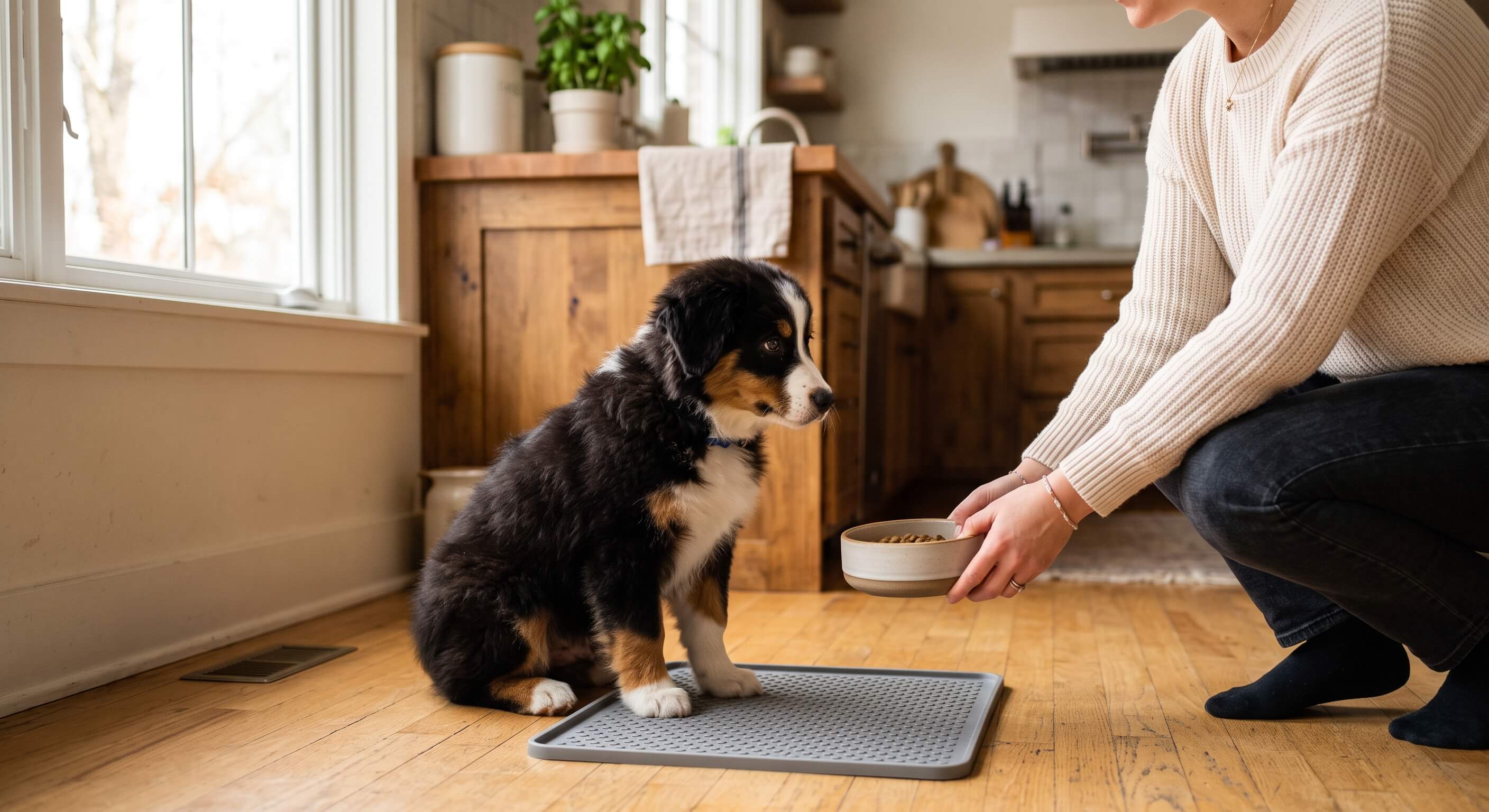
Puppy Feeding Schedule by Age: 8 Weeks to 12 Months
Bringing a puppy home changes the rhythm of your household overnight. Suddenly, your day revolves around house training, bursts of play, long naps, and trips to the food bowl. One of the first practical questions new owners face is how often and at what times their puppy should eat.
Feeding a growing puppy is about much more than putting a bowl on the floor. A consistent feeding routine provides structure, stabilizes daily energy, and acts as the primary anchor for potty habits and rest periods. At the same time, rigid schedules copied from the internet often cause unnecessary worry when real-world household timing or individual puppy needs do not match up.
This guide explains how a puppy's feeding pattern typically evolves from 8 weeks through the end of their first year, how to fit meal times into your day, and how to adjust their routine safely as they mature.
1. How a Puppy Feeding Schedule Changes During the First Year
During early puppyhood, growth happens rapidly, but a young puppy's stomach capacity is small. Very young puppies cannot comfortably digest an entire day's worth of food in one or two sittings. As a result, puppies between 8 and 12 weeks of age commonly eat multiple smaller meals spread evenly across the day.
As your puppy matures, digestive capacity expands, metabolism stabilizes, and daily activity shifts toward adult rhythms. Over the course of the first year, meal frequency generally decreases from three or four daily feedings down to two.
While developmental stages follow a predictable general pattern, feeding schedules are not governed by universal biological deadlines. A toy-breed puppy with limited energy reserves may need more frequent meals than a large-breed puppy of the same age. Similarly, puppies recovering from an illness or managing digestive sensitivities may follow a tailored feeding rhythm.
A feeding schedule should provide daily consistency without becoming an inflexible clock. Your puppy's specific complete and balanced diet, age, expected adult size, individual growth rate, body condition, and veterinary guidance should always take precedence over a generic timetable.
2. Puppy Feeding Schedule by Age
The table below outlines common meal frequency patterns and routine focuses across key developmental stages. Use these numbers as standard benchmarks rather than strict rules.
If you are unsure of their age in weeks, check the Puppy Age Calculator before reading the age examples. Meal count should still follow your puppy's individual feeding guidance.
| Age | Typical Meal Pattern | Routine Focus | What May Be Changing |
|---|---|---|---|
| 8 to 10 weeks | Commonly 3 to 4 meals daily | Settling into home; establishing predictable routine anchors | Transitioning from breeder or rescue setup to your household |
| 10 to 12 weeks | Commonly 3 to 4 meals daily | Integrating feeding with foundational training, sleep, and potty opportunities | Increasing wakefulness; developing clearer cues before and after eating |
| Around 3 months | Commonly 3 meals daily | Building dependable daytime rhythms; coordinating meals with nap schedules | Bladder control improves; daytime habits become more predictable |
| Around 4 months | Commonly 3 meals daily | Maintaining steady nutritional intake during heavy teething and growth | Energy levels shift; teething may temporarily alter interest in food texture |
| 5 to 6 months | Commonly 3 meals (some begin shifting to 2) | Observing whether midday appetite remains strong or begins tapering | Growth rate begins leveling off in small-to-medium breeds |
| 6 to 9 months | Commonly 2 to 3 meals daily | Settling into a sustainable, adult-like morning and evening feeding routine | Midday meal is frequently phased out if appropriate for size and health |
| 9 to 12 months | Commonly 2 meals daily | Maintaining stable body condition and predictable daily habits | Approaching physical maturity; some breeds begin discussing adult food timelines |
3. 8 to 10 Week Old Puppy Feeding Schedule
The 8 to 10 week window is a major transition. Your puppy has just left their mother and littermates, entered an unfamiliar environment, and is adapting to new caretakers.
During these first two weeks at home, your top priority is stability:
- Maintain their current food: Keep feeding the exact food recommended and provided by the breeder, shelter, or rescue organization. Abrupt dietary changes combined with the stress of moving can trigger acute digestive upset.
- Preserve initial meal timing: Replicating the puppy's previous rough meal times for the first few days helps them feel secure.
- Monitor active intake: Watch to confirm your puppy is actually eating their meals. Very young puppies, especially miniature and toy breeds, have limited reserves and should not skip meals.
- Anchor your day around events: Avoid stressing over exact minutes. Instead, link meals to a predictable sequence of daily events.
A reliable daily sequence at this age looks like this:
Wake up → Potty → Meal → Potty opportunity → Short activity → Rest
Feeding provides a natural prompt for digestion. Taking your puppy outside to their designated elimination area shortly after they finish eating helps prevent accidents and reinforces early house training. If you are building a broader routine for this stage, our Puppy Schedule by Age: 8 Weeks to 12 Months outlines how to balance rest and active hours.
4. 10 to 12 Week Old Puppy Feeding Schedule
By 10 to 12 weeks, your puppy is settling into their environment and showing more sustained wakefulness between naps.
Most puppies at this stage continue on three to four scheduled meals per day. While their digestive systems are maturing, their caloric needs relative to body weight remain high, making smaller, frequent portions the easiest way to ensure steady digestion without overloading their stomach.
Key priorities during this period include:
- Pairing food with foundational training: Reserve a small portion of your puppy's measured daily kibble allowance to reward basic behaviors, such as responding to their name, sitting quietly, or settling in their crate.
- Coordinating feeding around rest: Puppies this age still need frequent opportunities to sleep and rest. Meals can be incorporated into the puppy's existing cycle of waking, potty opportunities, activity, and rest without requiring an exact sleep timetable.
- Tracking elimination patterns: As your puppy grows, the interval between finishing a meal and needing to eliminate may shift. Observing these patterns helps you refine your Puppy Potty Training Schedule: A Complete Guide.
5. 3 to 4 Month Old Puppy Feeding Schedule
Between 12 and 16 weeks (around 3 to 4 months), many puppies settle comfortably into a three-meal-a-day rhythm: morning, midday, and early evening.
At this stage, you may see schedules prescribing rigid feeding times down to the minute. In reality, matching your household workflow is much more effective. If your household has breakfast, lunch, and dinner at consistent intervals, your puppy will adapt well as long as the spacing remains relatively consistent.
Around 14 to 16 weeks, puppies begin losing baby teeth and erupting adult teeth. Teething can sometimes cause mild gum discomfort, leading a puppy to eat more slowly or hesitate with dry kibble. If your puppy seems interested in food but chews cautiously, moistening their regular food with a little warm water can make mealtime more comfortable without altering their feeding schedule.
Always rely on the feeding instructions for your puppy's specific complete and balanced diet rather than generic online charts. Package guidelines provide a baseline daily intake, which you divide evenly across your puppy's daily meals. Adjustments should be guided by your puppy's ongoing body condition score and veterinary checks.
6. 5 to 6 Month Old Puppy Feeding Schedule
Between 5 and 6 months of age, physical development begins to show noticeable differences based on the puppy's breed and mature size.
Some puppies naturally show less enthusiasm for their midday feeding around this time. They may pick at their lunch, leave half of it in the bowl, or ignore it entirely while remaining energetic and eagerly finishing breakfast and dinner. For some puppies, consistently reduced interest in one meal may be one reason to review whether the current meal frequency still suits them. Age, expected adult size, body condition, diet, health, and veterinary guidance should all be considered before changing the routine.
However, this transition is not a universal mandate:
- Individual variation: Many puppies, particularly toy, small, or slender breeds with fast metabolisms, continue to thrive on three meals a day well past 6 months.
- Large and giant breeds: These puppies require particularly careful nutritional management during growth. They should receive an appropriate complete and balanced growth diet formulated for large-size dogs, with portion control and meal frequency suited to the individual puppy and veterinary guidance.
- Consult your vet: Before eliminating a meal, assess your puppy's growth rate and body condition with your veterinarian. The goal is steady, healthy growth, never pushing a puppy to skip a meal prematurely.
7. 6 to 12 Month Old Puppy Feeding Schedule
From 6 to 12 months, the majority of puppies gradually adopt an adult-like feeding schedule consisting of two meals per day: one in the morning and one in the evening.
It is critical to distinguish between two separate milestones that owners often conflate:
- Meal frequency: Moving from three meals to two meals per day.
- Dietary transition: Switching from a puppy growth formula to an adult maintenance formula.
Moving to two meals a day does not mean your puppy is ready for adult food. Puppies still require the concentrated nutrients, amino acids, and balanced mineral ratios of a complete and balanced puppy growth diet while their skeletal system and muscular frame continue to develop.
Large and giant breed puppies require an appropriate complete and balanced growth diet formulated specifically for their size to support controlled, healthy growth. Rapid growth or unmanaged weight gain can put unnecessary stress on developing bones and joints. Never add calcium, vitamin, or mineral supplements to an already complete and balanced growth diet unless directly instructed by your veterinarian.
Transition timing from a growth diet to an adult maintenance diet varies with the individual dog's growth and expected adult size. Large and giant breeds generally mature later than smaller dogs. Continue an appropriate growth diet until the puppy reaches the appropriate stage of skeletal maturity, following the food's guidance and your veterinarian's recommendation.
8. What Time Should You Feed a Puppy?
There is no universally optimal clock time to feed a puppy. A household where owners wake up earlier will operate on a very different schedule from one that starts the day later.
What matters far more than the numbers on the clock is consistency, spacing, and how meals integrate with your household routine.
When establishing your puppy's daily meal times, keep these practical factors in mind:
- Consistent spacing: Meals should be distributed in a reasonably consistent way that fits the puppy's required number of meals and the household routine.
- Post-meal potty access: Feeding should occur when caregivers can provide an appropriate post-meal potty opportunity.
- Evening routine: Evening feeding should fit a sustainable routine that allows the puppy appropriate opportunities to eliminate before settling for the night.
- Household sustainability: Build a schedule that fits your real work and family commitments. A schedule you can maintain consistently seven days a week is far better than an idealized routine you must abandon on busy weekdays.
Example Daily Sequences
Example 3-Meal Routine:
- Morning: Wake up → Potty trip → Breakfast → Potty opportunity → Play → Rest
- Midday: Wake up → Potty trip → Lunch → Potty opportunity → Rest
- Evening: Wake up → Potty trip → Dinner → Potty opportunity → Wind down → Bedtime potty
Example 2-Meal Routine:
- Morning: Wake up → Potty trip → Breakfast → Potty opportunity → Daytime activities and rest
- Evening: Potty trip → Dinner → Potty opportunity → Evening relaxation → Final bedtime potty
9. When Should a Puppy Go From Three Meals to Two?
One of the most common questions new puppy owners ask is when to reduce feeding frequency from three daily meals down to two.
There is no single calendar date or mandatory age for this change. Many puppies gradually move from three meals toward two as they mature, but there is no single transition age that is appropriate for every puppy.
Common Signs Your Puppy May Be Ready for Two Meals
- Consistent disinterest at midday: Your puppy regularly sniffs, ignores, or leaves significant portions of their lunch, but eats breakfast and dinner with healthy enthusiasm.
- Stable growth and body condition: Your veterinarian confirms that your puppy is growing steadily and maintaining lean, appropriate body condition.
- Reviewing the overall plan: Your puppy's appetite pattern, overall growth, body condition, health, expected adult size, and veterinary guidance support adjusting the routine.
How to Make the Transition Smoothly
When you and your veterinarian decide it is appropriate to drop the midday meal, do not simply remove that food from your puppy's daily intake.
- Calculate total daily allowance: Determine your puppy's total daily food portion based on their packaging instructions and veterinary advice.
- Divide across remaining meals: If reducing meal frequency is appropriate, redistribute the puppy's intended daily food across the remaining meals rather than simply removing the food from the discontinued meal. How the change is made can be adjusted to the individual puppy.
Situations Requiring a More Cautious Approach
Certain puppies should remain on three or more meals for longer:
- Toy and miniature breeds: Very small puppies have limited metabolic reserves and smaller stomach capacity, making them more sensitive to long gaps between meals.
- Puppies with medical sensitivities: Dogs prone to bilious vomiting (throwing up small amounts of yellowish bile when the stomach stays empty too long) or specific metabolic concerns often do best on three smaller, evenly spaced meals.
If you are ever uncertain whether your puppy is ready to drop a feeding, seek personalized guidance from your veterinarian.
10. Scheduled Meals vs. Free Feeding
Free feeding refers to leaving a bowl of food accessible all day, allowing the puppy to graze whenever they choose. Scheduled feeding involves offering measured meals at planned times rather than keeping food continuously available.
While free feeding may appear convenient, structured mealtimes offer distinct practical advantages for young puppies:
- Noticing appetite shifts: Scheduled feeding lets you know immediately if your puppy refuses a meal or eats less than usual.
- Predictable elimination: Scheduled meals make it easier to observe how eating relates to the puppy's individual elimination patterns, which can be useful during housetraining.
- Caregiver coordination: Multiple household members can easily verify whether the puppy has been fed.
- Preventing food competition: In multi-pet homes, scheduled meals prevent one pet from overeating or guarding the bowl.
Free feeding may work in rare individual situations, but it makes exact daily intake and elimination patterns much harder to observe. Scheduled meals do not mean rushing a puppy.
11. Feeding, Potty, Sleep, and Play: How the Routine Fits Together
A feeding schedule does not function in isolation. In a puppy's daily life, meals, bathroom breaks, active play, and sleep are tightly linked.
Rather than watching the clock constantly, think of your day as a repeating cycle:
Wake → Potty → Meal → Potty opportunity → Activity or Training → Rest
Meals are a useful potty-training trigger because puppies commonly need an opportunity to eliminate after eating. The exact timing varies, so observing your own puppy's pattern is more useful than relying on a fixed number of minutes.
For deeper insights into how physical maturation influences bathroom timing, review our guides on How Often Should a Puppy Pee? Puppy Potty Schedule by Age and How Long Can a Puppy Hold Their Pee?.
12. Using Meals for Puppy Training
Training is an essential part of raising a confident puppy, but loading a young dog with rich, store-bought training treats can upset their digestive tract or cause unintentional weight gain.
A practical solution is to use part of your puppy's measured daily food allowance during training exercises:
- Measure the daily allowance first: In the morning, measure your puppy's total recommended daily food portion into a container.
- Use normal food for training when practical: Part of the puppy's normal measured food allowance can be set aside for daytime training sessions, hand-feeding, or puzzle toys.
- Account for total daily intake: All training food and treats contribute to total daily intake.
- Divide the remainder into meals: Split the remaining food evenly between your scheduled meal times.
This approach keeps your puppy motivated to learn while ensuring that training rewards fit into their balanced daily intake rather than overloading their system with unnecessary extras.
13. How to Tell Whether the Feeding Schedule Needs Adjusting
Puppies mature at individual rates. Rather than relying solely on calendar timelines, watch your puppy's physical cues and behavior to determine when routine adjustments are necessary.
Signs the Schedule May Need Modification
- Consistently leaving food: If your puppy consistently walks away from a specific meal while remaining vigorous and finishing other meals, they may be signaling readiness to reduce meal frequency.
- Noticeable digestive changes: Persistent changes in stool quality can have many possible causes, including dietary and medical factors. Do not assume that meal size or timing is the cause. Persistent or concerning gastrointestinal changes should be discussed with a veterinarian.
- Persistent food-seeking with poor body condition: If your puppy seems insatiably hungry, scavenges frantically, and appears overly ribby or underweight, their current portion size may not be meeting their growth demands.
- Changes in household logistics: If family schedules change, feeding times can be adjusted in a practical way while maintaining a reasonably consistent routine.
The Role of Body Condition
Feeding guides on pet food bags are formulated as starting estimates. Individual caloric requirements depend on metabolic rate, activity level, and growth stage.
Regularly check your puppy's body condition: you should be able to easily feel their ribs beneath a thin layer of fat without pressing hard, see a noticeable waistline behind the ribs when looking from above, and observe an abdominal tuck when viewing them from the side. If you are unsure whether your puppy's condition is ideal, bring them to your veterinary clinic for a quick weight check and professional assessment.
14. Tracking Your Puppy's Feeding Routine
Because eating, digestion, hydration, and sleep directly influence each other, tracking these events together helps you understand your puppy's unique biological patterns.
A single log entry often tells an interconnected story:
Breakfast → Water → Pee → Play → Poop → Nap
When you monitor daily routines consistently, you begin to see clear patterns emerge. You will notice how eating relates to elimination, how daytime activity influences appetite, and whether unexpected accidents coincide with schedule delays.
With Dogtales, you can keep feeding and other daily events in one timeline. Dogtales allows you to record meals, water intake, pee, poop, naps, training, and activity in a single unified timeline. When multiple family members or dog walkers care for the puppy, an integrated log prevents double-feeding, ensures missed meals are caught immediately, and keeps house training on track.
For practical advice on building consistent logs, read our guide on How to Track Your Puppy's Potty Schedule.
15. When Feeding Changes May Need Veterinary Attention
Puppies have less physical reserve than adult dogs, meaning sudden appetite loss or digestive symptoms warrant careful observation.
Do not wait for arbitrary timelines if your puppy appears noticeably unwell. Contact your veterinarian promptly if you observe any of the following warning signs:
- Repeated food refusal: Repeated food refusal or a significant change in appetite can warrant veterinary advice, particularly in a very young puppy or when accompanied by other symptoms. Very young and toy-breed puppies can be more vulnerable to hypoglycemia.
- Sudden, profound appetite drop: A puppy that was previously eager to eat and suddenly shows zero interest in any food should be checked.
- Accompanying gastrointestinal distress: Repeated vomiting, persistent watery diarrhea, or blood in the stool combined with food refusal.
- Lethargy and behavioral changes: A puppy that refuses food and seems unusually weak, unresponsive, or unwilling to interact.
- Signs of physical pain or distress: Whining when approaching the bowl, drooling excessively, swallowing with difficulty, or showing signs of abdominal discomfort.
- Failure to thrive: Inability to gain weight steadily, a dull coat, or an abnormally protruding, bloated abdomen alongside poor muscle condition.
Trust your observations. If something feels noticeably abnormal about your puppy's appetite, energy, or elimination, consulting your veterinary team is always the safest course of action.
Frequently Asked Questions
How many times a day should I feed my puppy?
Young puppies generally benefit from multiple small meals spread through the day, and meal frequency commonly decreases as they mature. The appropriate number depends on your puppy's age, size, diet, health, and individual needs. Follow the feeding guidance for your puppy's specific complete and balanced diet and ask your veterinarian if you are unsure when to reduce meal frequency.
What time should I feed my puppy?
There is no universal clock time. The best times are those you can maintain consistently every day. Typical routines include breakfast shortly after waking, lunch in the middle of the day (if feeding three meals), and dinner scheduled to allow appropriate opportunities to eliminate before settling for the night.
When should a puppy go from three meals to two?
Many puppies gradually move from three meals toward two as they mature, but there is no single transition age that is appropriate for every puppy. Readiness depends on appetite patterns, overall growth, body condition, expected adult size, and veterinary advice. Very small breeds or puppies with digestive sensitivities may benefit from remaining on three meals longer.
Should I feed my puppy before or after a walk?
A calm potty outing or gentle walk around mealtime is different from strenuous exercise. Avoid intense exercise immediately around a large meal, particularly in dogs at increased risk of gastric dilatation and volvulus (GDV). For ordinary puppy activity, consider the puppy's size, meal size, activity intensity, and veterinary guidance rather than relying on a universal waiting period.
Should puppies have food available all day?
Scheduled meals are generally recommended over leaving food available all day. Structured mealtimes make it much easier to notice appetite changes, track total daily consumption, prevent food guarding or overeating, and observe elimination patterns.
Should puppies have water available all day?
Puppies should have continuous access to clean, fresh water throughout the day. Restricting normal water intake simply to prevent potty accidents is not recommended and can risk dehydration. You can discuss appropriate evening hydration management with your vet if nighttime house training is a challenge, but water should never be routinely withheld during the day.
When should a puppy switch to adult food?
The transition from a growth diet to an adult maintenance diet depends on the individual dog's growth and expected adult size. Large and giant breeds generally mature later than smaller dogs. Continue an appropriate growth diet until your puppy reaches the appropriate stage of skeletal maturity, and follow both the diet's guidance and your veterinarian's recommendation for when to make the switch.
Why is my puppy suddenly not finishing meals?
Sudden changes in appetite can stem from teething discomfort, transition readiness toward fewer meals, receiving too many training treats between meals, subtle illness, or environmental stress. Evaluate symptom severity, persistence, the puppy's age, and accompanying symptoms, and contact your veterinarian if food refusal persists or is accompanied by signs such as vomiting, diarrhea, or lethargy.
Should I track my puppy's meals?
Yes. Tracking meal times, food amounts, water consumption, and subsequent potty trips in an app like Dogtales helps you spot appetite changes early, identify patterns that can help you anticipate potty needs, and keep all household members aligned on your puppy's daily routine.
Share this article
Keep your dog healthy and happy with Dogtales
Track meals, medication, potty breaks, weight, vaccinations, and daily reminders in one intuitive app.
Related Articles

First Week With a Puppy: What to Expect
The first week with a puppy is about safety, basic needs, gentle routine, and helping them adjust. Learn what to expect, what to prioritize, and how to navigate the first seven days realistically.
New Puppy Checklist: What You Actually Need
Bringing home a puppy does not require an endless shopping cart. Here is a practical, realistic checklist of what you actually need before day one, what can wait, and the non-product preparation that matters most.
Puppy Daily Routine: What to Track in the First Year
A useful puppy routine is not about making every day identical. Learn which daily events are actually worth tracking, how to identify meaningful patterns, and how to avoid tracking overload.